Login
Login
Shipping Country
Super CLEARANCE CAMPAIGN - Selected tools and accessories with Super Special prices! - CHECK HERE
READ MORE
Login
A band saw is one of the most versatile basic tools in a workshop. It is suitable for splitting thick planks, making precise curved sawing, and producing thin veneers. When looking for a suitable machine, you will come across a wide range of prices. The cheapest table models cost hundreds, while more robust and sturdy workshop machines cost well over a thousand euros.
The large price difference raises questions about where the real differences between the devices come from. Does a more expensive machine offer real value for money or is it just a well-known brand? The materials used to make the tool, technical solutions and mechanical structure directly affect the sawing experience and the after-work experience. Below we will find out how much it is worth paying for a functioning machine so that the work goes smoothly without ruined workpieces.
The price of a band saw is not determined by engine power or appearance alone. Most of the value of the device lies in its mechanical structure and materials, which may not be noticeable at first glance. One of the most important features is the rigidity of the frame. When the blade is tightened for use, hundreds of kilograms of compressive force are applied to the frame of the band saw.
Cheap machines often use a thin, pressed sheet metal frame. When the blade is tightened, the sheet metal frame flexes and bends slightly. This makes it impossible to keep the blade straight. In higher-quality machines, the frame is welded from a thick steel profile or cast from cast iron. The rigid structure keeps the blade stable and ensures that the set adjustments are maintained throughout the sawing process.
Another major cost factor is the bandsaw wheels around which the blade runs. Budget-class machines have wheels made of lightweight aluminum or plastic, while higher-end machines use heavy cast iron wheels. The cast iron wheel acts like a flywheel. When it reaches full speed, its inertial mass helps to keep the speed constant, even when the blade encounters dense wood grain or knots. This reduces the load and vibration on the motor, ensuring a smooth cut.
There are clear price categories in the band saw market, which makes it easy to understand what you get for your money. If your goal is to do precise woodworking without constant adjustments and failed cuts, there is a clear limit to the quality of the machine.
The price range under 300 euros is mainly made up of lightweight table models. These devices typically weigh less than 20 kilograms and have a thin sheet metal frame. While they are suitable for occasional crafts and shaping thin plywood, they are not suitable for precision work. The frame flexes easily, the vibration is strong and the plastic blade guides are often difficult to adjust.
The optimal price range for a high-quality basic machine starts at around 800 euros and goes up to around 1,500 euros. In this price range, devices already weigh over 70 kilograms, which directly indicates a sturdy structure and heavy cast iron parts. With a machine of this level, you can split planks over 200 mm thick evenly without the motor freezing or the blade wandering. These devices offer hobbyists and semi-professionals the best value for money, as they maintain their accuracy for years. You can explore this category in more detail and see the selection of high-quality band saws , which are designed to withstand heavy use.
Professional machines priced over €1,500 feature larger jaw clearances, more powerful motors, and precise control systems. These machines are designed for continuous use in workshops where absolute reliability and performance are required from the saw in daily work.
One of the most common issues that bandsaw users face is sawing at an angle, or blade wandering. When you try to push the workpiece straight against the fence, the blade starts to curve either to the left or right, resulting in a crooked and ruined piece of wood. The problem is usually not due to the user's skill, but to the laws of physics and the machine's structural flaws.
The root cause of blade wandering is too low a blade tension. In order for the blade to remain straight when it meets the wood fibers, it must be very tight. The required tension values ??are high: a standard carbon steel blade often requires 15,000–20,000 PSI of tension to function properly. In cheap saws, the thin sheet metal frame or weak clamping mechanisms cannot withstand such a load. If you try to tighten the blade tightly enough on a cheap machine, the frame will bend or the clamping screw threads will give way before the correct tension is achieved.
An insufficiently tightened blade will be loose. When it encounters the wood grain, it will take the easiest path and bend to the side when it encounters harder grains. Looseness makes it impossible to make a straight cut, even if you adjust the guides or press the wood firmly against the fence.
As the price range of a band saw increases from the basic level upwards, the investment is directed towards components that improve the smoothness and accuracy of work. In a quality saw, the technical details are designed to eliminate typical operating difficulties, saving both time and material.
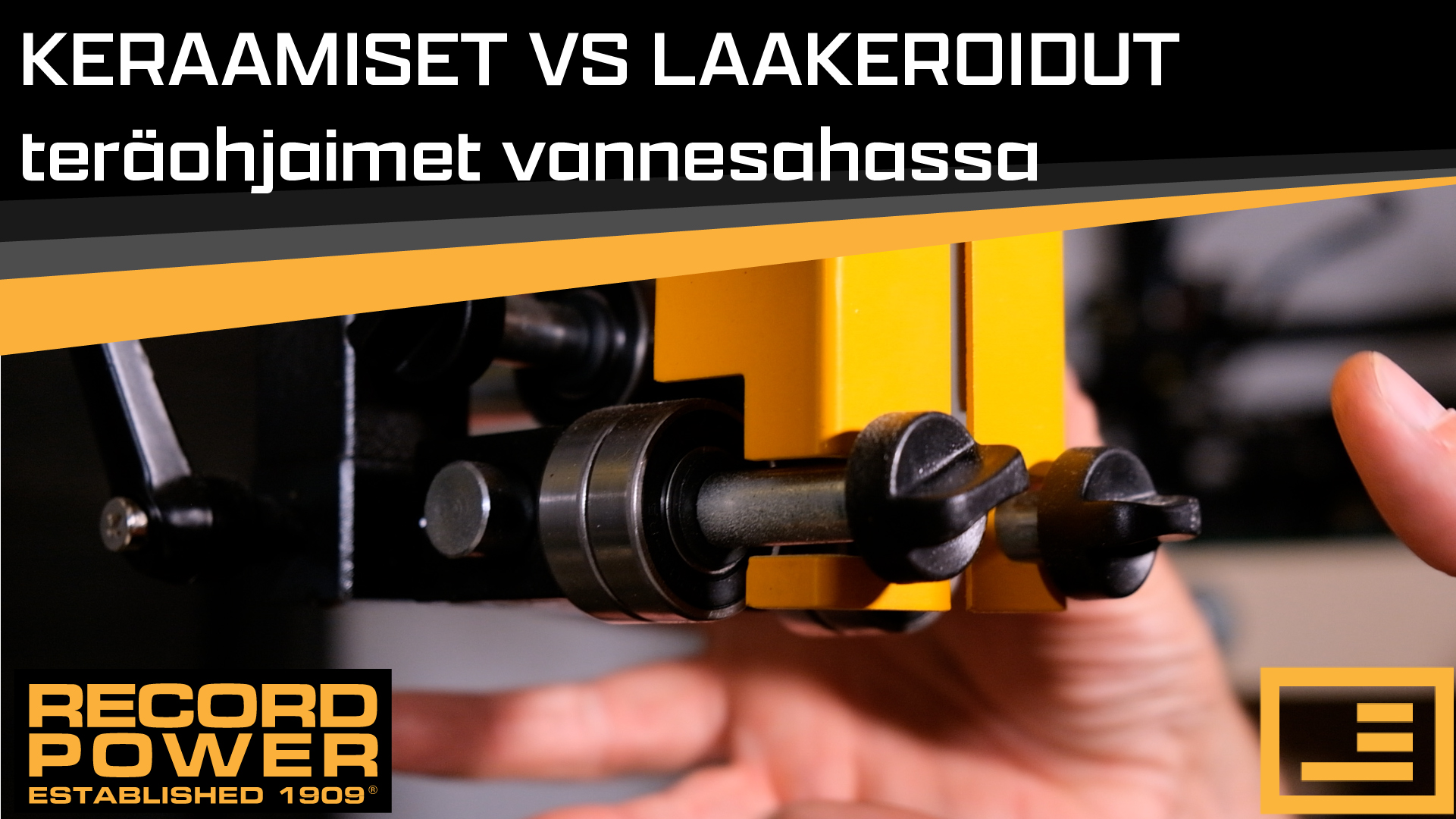
One of the most important components is the blade guide. Cheap models often use simple metal bushings, which wear out quickly and heat up the blade. Better devices use either ball bearings or ceramic guides for guidance. Ceramic guides provide a wide support surface without the bearings wearing out or binding. This keeps the blade stable even during heavy splitting and the wood surface becomes smooth without waviness.
Another important mechanical solution is the rack and pinion adjustment on the guide arm. This allows the upper blade guide to be adjusted to the exact height above the workpiece with one hand movement. When the adjustment is done precisely without any tools, the guide is also placed on a safe and stable level for every saw. In addition, the quick-lock blade tension saves effort and extends the service life of the blade. At the end of the working day, the tension is released by turning a lever, so that the blade and the rubbers on the pulleys are not subjected to unnecessary stress.
Buying a used band saw is often tempting when you want a heavy cast iron machine, but the price of a new one is beyond your budget. Old and sturdy cast iron machines can be excellent in their frame, but there are hidden costs involved in buying a used machine that should not always be taken into account.
Before making a purchase, an old machine always requires a thorough condition check. In used equipment, wearing parts are often in a condition to be replaced. In particular, the rubber surfaces of the pulleys dry out, crack and wear down over time. If the rubber is uneven, the blade will not stay in the center of the wheel but will start to wander. The bearings of the motor and wheels may also be worn out, which is manifested as vibrations and a grinding sound.
According to industry experts, a thorough overhaul of an old machine – replacing bearings, tires, guides and belts – can easily raise the final price to the level of a new machine with a warranty. Buying a used one is only worthwhile if the mechanical parts are proven to be in good condition and the availability of spare parts is assured. Otherwise, overhaul can be expensive and take weeks of workshop time.
To avoid purchasing the wrong equipment, compare the dimensions of your band saw to your actual projects. A typical mistake is to buy a machine that is too big just to be safe, but there is no space or need for it in your workspace. The other extreme is to save money in the wrong place and buy a flimsy machine that cannot split thicker wood.
The most important dimensions to consider are the jaw distance and the cutting height. The jaw distance determines the maximum width of the workpiece between the blade and the frame. The cutting height, in turn, indicates the thickness that the machine can split. If you are making musical instruments, furniture, or splitting thick planks into thin veneers, for example, you need a sawing height of at least 200–300 mm and a frame that can withstand the tension required by the wide splitting blade. A high-quality, smaller table model is perfect for processing thin plywood sheets and small jewelry boxes.
The price of a band saw is directly correlated to the comfort of use, safety and quality of work. Investing in a sturdy machine with cast iron parts and a rigid frame will give your workshop a tool that will produce accurate results for years without constant adjustment and frustration. Choosing a quality device is an investment in the smoothness of your work and the end result.
Choosing the right band saw often raises questions. We are happy to help you find the best machine for your workspace and needs. The equipment we import represents reliable quality, and our expert service ensures that you get just the right solution for your projects.
Discover the selection in the Nettiverstaan ??online store100% Trustworthy online store with history
Expert customer service
Fast deliveries
Large selection directly from stock
No middlemen - save on the price






 Suomeksi
 På Svenska