Login
Login
Shipping Country
Super CLEARANCE CAMPAIGN - Selected tools and accessories with Super Special prices! - CHECK HERE
READ MORE
Login
Quick guide to choosing the right turning chisel: Choosing the right chisels for your wood lathe depends entirely on whether you are working with long-grain wood (spindle turning, such as table legs) or cross-grain wood (bowl turning). The basic set of a spindle turner includes a roughing chisel, a groove chisel and a diagonal chisel, while making bowls requires a sturdy cup chisel. It is always a good idea to choose HSS high-speed steel as the material, which retains its hardness even when heated and holds its edge for a long time. With the right tools, you will ensure a clean surface, avoid dangerous kickbacks and save time on grinding.
Turning is one of the most beautiful and addictive forms of woodworking. As the wood lathe turns and the chips fly, you can see and feel the progress of the work immediately. But if you have the wrong or poor-quality chisel in your hands, the hobby quickly turns into a frustrating struggle – or at worst, a dangerous one. In woodturning, the chisel is the only thing that directs the cutting force between the rotating piece of wood and your arms.
Just as high-quality router bits determine the final result of the work in routering, the quality and shape of the chisel in woodturning also determine how clean the result will be. Choosing the right blade profile is not just a matter of tinkering. It directly affects occupational safety, surface quality and how much time you have to spend with sandpaper in the dust. The wrong chisel will tear the wood, the blade will bark and, in the worst case, the workpiece will be thrown out of its holder. A high-quality and properly sharpened chisel, on the other hand, cuts through wood like butter, leaving behind a surface that only requires a light finishing before surface treatment.
In woodturning, chisels are divided into two main groups depending on what is being done: spindle turning and bowl turning. In spindle turning, the grain of the wood runs parallel to the lathe guides (for example, table legs, pens, mallets, and candlesticks). In bowl turning, the grain is transverse to the direction of rotation, so the bit constantly encounters discontinuous grain.
This division determines which chisel profiles can be safely used. Each profile has its own specific function, and no one blade is meant to do everything. Understanding the mechanical differences between different profiles and the way they interact with the wood grain will save you a lot of teeth grinding. Below, we’ll go over the five most important chisel types that will help you get by on almost any turning project.
When you attach a square piece of wood or a branch to a wood lathe, the first task is to turn it into a round cylinder. A roughing gouge is used for this task. It is a wide, deep U-shaped chisel that removes material quickly and efficiently. The large, deep shape of the blade effectively deflects the chips and prevents the blade from sinking too deep at once.
However, there is one vital rule associated with this chisel that should never be broken: the roughing chisel may only be used for spindle turning! Never use it for hollowing out or turning bowls or other cross-grained pieces. The tang of a roughing chisel is usually narrow and cannot withstand the impacts and forces that occur when working with cross-grained wood. The blade can break off at the root and fly in your face. Before you lift the bowl blank onto the lathe, it is often wise to round off the corners a little, for example, so that high-quality band saws can do the pre-processing for you – this will save both the turning blade and your nerves.
Once the workpiece has been shaped into a round cylinder with a roughing chisel, the actual shaping begins. A spindle gouge is a true all-purpose tool for spindle turning. Its profile is considerably lower than that of a roughing chisel, and the sides of the blade are often ground slightly back in a claw-like shape. This design makes it ideal for accessing tight spaces, grooves, and steep shapes.
The groove chisel is used to create traditional turning shapes: coves and beads. Controlling the blade requires some practice, as the cutting edge and the bevel must be in contact with the wood at all times during the cut. Once the technique is mastered, the groove chisel produces an incredibly precise and clean cut that beautifully brings out the natural patterns of the wood without tearing.
The skew chisel is a tool that many beginners fear – and rightly so. However, it is a lathe operator’s best friend once you master the technique. A skew chisel is a flat chisel with a cutting edge ground at an angle on both sides.
Unlike most other chisels, which partially scrape the wood, a diagonal chisel works like a hand plane. It cuts across the wood fibers very cleanly. When used correctly, a diagonal chisel leaves behind a surface so smooth that it doesn’t even need to be sanded before finishing. The secret is that you only cut the wood with the middle of the blade (never the very tip or the base), and let the bevel of the blade, or support, slide over the surface of the wood to guide the cut. If the upper tip of the blade catches on the rotating wood, the result is a split-second kickback (catch) that makes an ugly mark on the workpiece. But once you learn the tricks of this tool – for example, by practicing on inexpensive pine first – you won’t want to give it up.
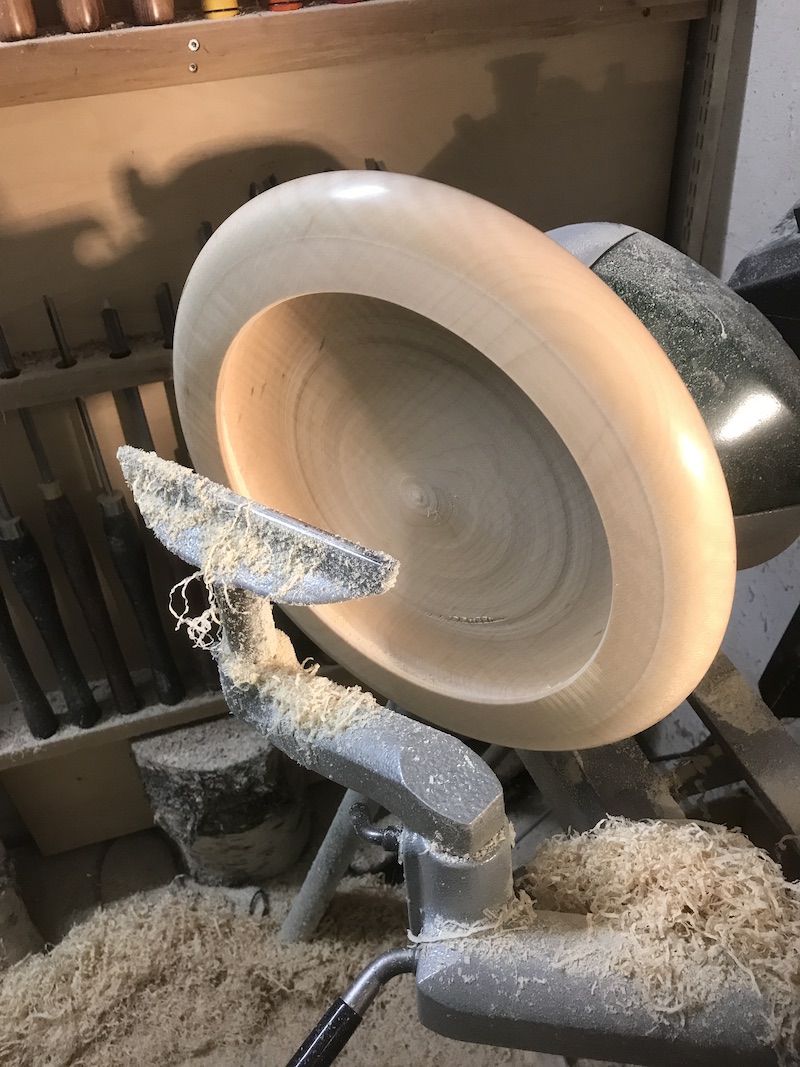
For many, turning bowls, cups and plates is the main reason why a wood lathe is purchased in the first place. In bowl turning, the grain of the wood runs transversely, so the tool is constantly subjected to intermittent blows as the grain of the wood changes during rotation. A bowl gouge, sometimes called a bowl gouge, is absolutely necessary for this work.
The cup chisel is made from a round solid bar into which a deep groove is milled. This round and massive structure is excellent at withstanding the high forces and vibrations generated when turning cross-sections, and does not flex in the same way as thinner chisels intended for spindle turning. Cup chisels are available with various grinding profiles, the most popular of which is the so-called fingernail grind (Ellsworth grind). This makes the chisel extremely versatile, allowing the same tool to perform both rough shaping of the outer surface and delicate hollowing of the inner side all the way to the bottom.
A scraper works, as its name suggests, by scraping the surface of the wood rather than cutting it. It does not cut the fibers in the same way as a flute or diagonal chisel, but rather removes the wood in very thin slices and dust. A scraper is mainly used for finishing the insides of bowls and other hollow shapes where working with cutting tools is difficult or dangerous.
The power of a scraper is based on the small thread, or burr, created when the blade is ground. This small burr acts as a sensitive microscopic cutting edge. The scraper is always used below the centerline of the lathe and the blade is pointed slightly downwards to avoid biting the blade. It is the perfect tool for smoothing out small irregularities and turning marks before the grinding stage.
When browsing the chisel selection, you will quickly come across two main materials: traditional carbon steel and high-speed steel (HSS – High-Speed ??Steel). This is where you shouldn’t skimp if you want to save yourself some nerves in the workshop.
Carbon steel chisels are inexpensive and can be sharpened to a very sharp point, but they have a major weakness: they lose their hardness very easily if the blade gets too hot during sharpening. If the blade turns blue when sharpening, it has become tempered, meaning it has lost its hardness and softened, and will no longer hold its edge. HSS steel, on the other hand, is extremely heat-resistant. You can sharpen it on a dry face without fear of losing its hardness. In addition, an HSS steel chisel will hold its edge many times longer than a carbon steel one, which means less time at the face and more time at the lathe itself.
When you do a lot of turning, you quickly notice how much shavings and fine dust are produced during the machining process. That's why efficient dust extractors are a standard feature in every woodworking shop - it's much more convenient to collect wood dust in a bag than to breathe it into your lungs.
It's easy for a beginner to fall for the cheap, multi-piece starter kits that are sold at thrift stores for a few bucks. These kits are almost invariably made of soft carbon steel, dull in minutes, and their blade profiles can be dangerously thin or misshapen. Forget about them and invest in proper tools from the start.
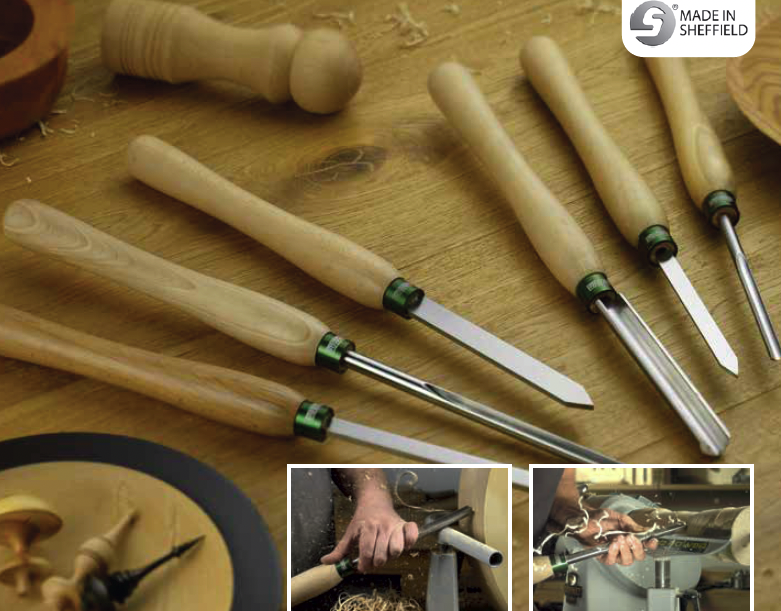
Invest in quality over quantity. 3-5 high-quality HSS chisels will cover 95% of all your turning needs for a long time. A good and balanced starter kit includes:
Nowadays, many industrial wood products are manufactured fully automatically, and modern CNC machines handle mass production with incredible precision and speed. However, there is something soulful and creative about handcrafting and traditional woodturning that no machine can replace. The feeling when a quality chisel bites into the wood at just the right angle and a long, continuous strip of wood flies over your shoulder – it is the best therapy in the midst of a busy everyday life. So get yourself some good chisels, keep them sharp and let the wood take you with you!
100% Trustworthy online store with history
Expert customer service
Fast deliveries
Large selection directly from stock
No middlemen - save on the price






 Suomeksi
 På Svenska