Login
Login
Shipping Country
Super CLEARANCE CAMPAIGN - Selected tools and accessories with Super Special prices! - CHECK HERE
READ MORE
Login
Milling a groove in wood is an everyday task in the workshop. However, the quality of the end result and the smoothness of the work vary greatly depending on the blade used. Many woodworkers struggle with torn groove edges, burnt wood or clogged grooves. Often these problems can be solved simply by changing the blade type. The right choice saves time and effort, as the subsequent grinding and cleaning is then minimized.
The choice between a traditional straight flute blade and a helical spiral blade directly affects the cutting process, chip removal and machining safety. Both have their place in the workshop, but their operating principles differ significantly. Next, we will look at how these two popular blade types behave in a machining situation and why the result they produce is so different.
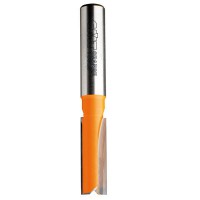
The main difference between a straight flute and a spiral flute lies in the geometry of the cutting edges and how they meet the wood fibers. In a traditional straight flute, the cutting edges run completely parallel to the blade's axis of rotation. As the router rotates at thousands of revolutions per minute, the straight cutting edge strikes the wood with its flat face. The impact creates vibration and stresses both the machine and the material being machined. At the same time, the risk of tearing the wood fibers at the edges of the flute increases.
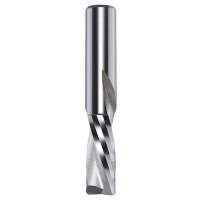
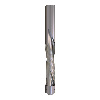
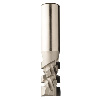
A spiral blade, on the other hand, works in a different way. Its cutting edges spiral around the blade shank, similar to a twist drill bit or a planer's spiral shaft. Thanks to the spiral structure, the blade does not hit the wood all at once. It cuts the wood grain in a continuous, sliding and beveling motion. The cutting edge contacts the material at a steadily changing angle, making the work considerably less vibration-free and quieter.
The shape of the blade also directly affects chip removal. When cutting a deep groove, a straight groove blade easily leaves the chips spinning at the bottom of the groove, as the blade does not have a lifting mechanism. As a result, the blade heats up and the advancement slows down. The spiral structure, on the other hand, acts like a screw, effectively transporting the chips and chips out of the groove either up or down, depending on the direction of the thread. Therefore, the appropriate milling cutter is always selected according to the depth of the groove to be machined and the material to be machined.
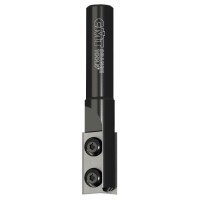
There is no direct answer to the question of which blade is better without defining the intended use. The decision depends on the budget, the material being machined, and the required surface finish. A traditional straight slotting blade with carbide inserts is more affordable. It defends its place in basic work where a small burr on the slot edges or slow machining is not of great importance. It serves as a reliable basic tool when milling randomly and for short distances at a time.
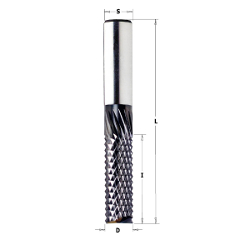
When moving on to solid wood or chipping-prone board materials such as coated plywood and MDF, a solid carbide spiral blade is a clearly more efficient option. Since these blades are usually made entirely from a solid carbide rod, their cutting edges can be sharpened to be extremely sharp and durable. Although the purchase price of a solid carbide spiral blade is higher, the long service life, clean finish and faster cutting speed it offers will save you time and money in the long run.
The high cutting speed of a spiral cutter is based on efficient chip removal, which reduces the cutting edge’s heat build-up and prevents the groove from clogging. Good chip removal allows you to use higher feed rates without fear of cutting edge breakage or damaging the workpiece. If your shop does a lot of grooving or does demanding CNC machining, a spiral cutter is an excellent investment for quality work.
High-quality blades make milling effortless. In Nettiverstaa's selection you will find professional-level milling blades that withstand heavy use and leave a clean finish. Explore the selection and get the blades that are right for your job.
EXPLORE THE RANGEOne of the most common and annoying problems in milling is wood burning, which leaves an ugly black burn mark on the bottom and edges of the groove. It is often thought that the cause is the type of wood or poor quality material. However, the cause is almost invariably too low a feed rate in relation to the speed of the milling cutter, a dull cutting edge or resin accumulated on the surface of the blade.
When the milling cutter is rotating at high speed, but the machine is moved forward too slowly or it is stopped for a moment in the middle of the work, the cutting edges do not have time to cut new wood. They begin to rub against the already cut surface. The friction immediately generates a huge amount of frictional heat, which cannot escape from the groove. The temperature rises so high in seconds that the wood fiber begins to char.
Another significant factor is the resin and adhesives released from the wood, which stick to the hot blade. Especially when working with softwoods or plywood, a hard, almost invisible film quickly forms on the blade surface. The film layer acts as an insulator, preventing heat from transferring from the blade to the air and increasing friction even more. A dull blade makes the situation worse. It is unable to cut the wood cleanly, but crumbles and compresses the fibers, generating heat instead of cutting.
The physical size of the tool determines the speed of rotation of the router. The selection of the correct speed is based on the peripheral speed, i.e. the speed at which the outer edge of the blade meets the wood. The larger the diameter of the router bit, the greater the distance its outer edge travels in one rotation. If a large profile bit is set to rotate at the maximum speed of the machine, the speed of the outer edge increases dangerously high. This creates strong vibrations and quickly burns the wood surface, ruining the workpiece.
Small router bits, less than 12 mm in size, require high RPM to maintain a sufficient cutting peripheral speed for clean machining. 20,000–24,000 RPM can be safely used for these. When moving to larger bits, the RPM must be reduced. A more moderate RPM protects the router bearings and ensures that the cut remains smooth without rough tears or dark burn marks.
The most common millimeter-sized collets for routers used in Europe are 6 mm, 8 mm and 12 mm in diameter. The thickness of the shank directly affects the machining safety and the cleanliness of the end result. A thicker shank gives the blade more mass and torsional rigidity. For example, a router bit with a 12 mm shank can withstand lateral loads much better than a thin 6 mm shank. Less deflection eliminates harmful vibrations and micro-vibrations. This prevents a wavy pattern from forming in the groove, which saves time on post-processing.
The workshop must be careful with millimeter and inch-sized parts. Milling cutters with 1/4 inch (6.35 mm) or 1/2 inch (12.7 mm) shanks available from foreign online stores may seem suitable for Finnish 6 mm and 12 mm collets. However, using them crosswise is dangerous. If you try to squeeze a 6 mm shank into a 1/4 inch collet, the clamping will not be even. The blade can loosen and come off during machining as it rotates at high speed. Therefore, always use blades that exactly match the dimensions of the collet.
Making a smooth-edged groove in materials that are prone to splitting requires knowing the direction of the spiral blades' threads. Unlike straight groove blades, spiral blades are designed to direct the cutting force either up or down. The direction of the threads determines whether the surface fibers will stand up and tear away from the surface of the board or solid wood being worked.
Up-cut bits (positive spiral) pull chips and wood chips upwards towards the cutter body. The spiral effectively empties the bottom of the groove, making it easier to make deep joints and recesses. However, the spiral can lift the surface fibers of the material with it, which can easily cause burrs and tears at the top of the groove. A positive spiral bit is best suited for through holes or situations where the top of the groove is hidden by other structures.
Down-cut blades (negative spiral) work the opposite way, pressing the chip and cutting force downwards into the workpiece. The downward pressure holds the surface veneers and fibres firmly in place during the cut. This results in a very clean top edge of the groove in, for example, oak veneered plywood or coated MDF. However, the chips pack down to the bottom of the groove, which is why a moderate feed rate must be used for deep grooves and the machining must be divided into several passes.
Compression blades combine both directions. In them, the lower part of the blade pulls the sawdust upwards and the upper part presses it downwards, so that the cutting forces meet in the middle of the board. The special structure is suitable for processing double-sided coated boards, as it prevents tearing on both the top and bottom surfaces of the board. This avoids patching and the creation of scrap.
Choosing the right blade type and thread structure improves the quality of your work and saves material. When you identify the challenges posed by the material and match the blade geometry, shank size and speed to the machining, grooving becomes smooth and clean. At the same time, you avoid burn marks and frayed edges. Working with high-quality tools is effortless and the end result is clean.
High-speed steel bits are tough and can be honed very sharp, but they soften and go blunt quickly in heat. Carbide bits withstand high temperatures and abrasion far better. They hold their edge many times longer and suit hardwoods, plywood and MDF.
As a rule of thumb the depth taken in one pass should not exceed the diameter of the bit — at most 8 mm of depth with an 8 mm bit. Deep grooves should always be cut in several steps. That reduces the load on the bit, prevents breakage, improves chip clearance and stops the wood burning.
In conventional milling the machine is fed against the bit's direction of rotation, which is standard and the safest way to work with a hand-held router. In climb milling the machine is moved with the direction of rotation; this can reduce grain tear-out, but the machine may snatch out of your hands. When working freehand, always favour conventional milling.
The face of a carbide bit can be wiped lightly with a diamond file to maintain the edge, but real grinding requires professional equipment. Grinding done wrongly changes the bit's profile and diameter and can create imbalance, which leads to dangerous vibration and reduced performance.
100% Trustworthy online store with history
Expert customer service
Fast deliveries
Large selection directly from stock
No middlemen - save on the price






 Suomeksi
 På Svenska