Login
Login
Shipping Country
Super CLEARANCE CAMPAIGN - Selected tools and accessories with Super Special prices! - CHECK HERE
READ MORE
Login
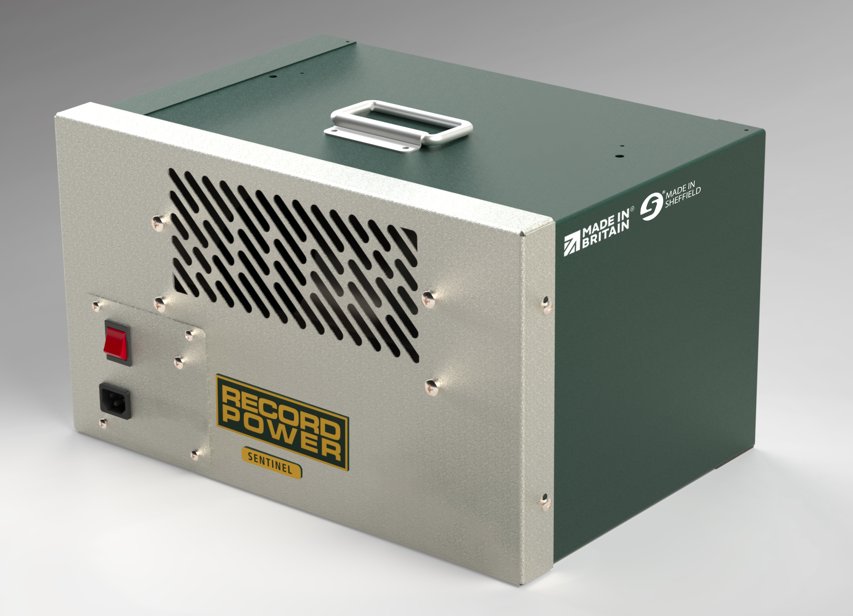
The most dangerous dust in a workshop is the dust you cannot see. Chips visible to the eye settle on the floor within seconds. Particles below one micron stay airborne for hours, reach the alveoli and are not coughed back out. Those are what an air filter exists to remove.
That makes the only meaningful measure of an air filter how small the particles are that it captures, and how much air it manages to process. Everything else — timers, remotes, speed settings — is built around that.
Filter performance is now described with the ePM rating. ePM1 refers to particles below one micron, and the figure states what share of them the filter stops.
Record Power's new Sentinel is 98 % ePM1. For comparison, the AC400 — for years the workshop default — is ePM2.5 and stops 55 % of particles below 2.5 micron. That is not a nuance: the Sentinel captures nearly all of the fine dust that passes straight through an AC400.
The filter technology matters just as much. The Sentinel's filter is mechanical. Some machines on the market use electrostatic filters whose performance depends on a charge — and that charge decays in use. A mechanical filter performs as well on its last day as on its first.
This is where product comparisons most often go wrong. Many manufacturers state airflow without a filter. It makes a good brochure number and tells you nothing: the machine is never used without a filter.
The denser the filter, the more it resists airflow. That is exactly why a better filter demands a better fan — otherwise the air simply does not pass through it.
The Sentinel's figure is 750 cfm, measured with the filter fitted. The AC400's stated figure is 409 cfm without a filter. The gap is therefore wider than the numbers suggest at first glance.
It also explains why fitting a better filter to an AC400 is not the answer. The filter physically fits, but the AC400 cannot generate the pressure needed to drive air through a denser medium. The Sentinel uses a French-made industrial fan, and the whole machine is engineered around that pressure.
The Sentinel's feature list looks short on a spec sheet. That is deliberate.
The Sentinel is 45 % smaller than the AC400 — 250 × 425 × 280 mm and 14 kg. It mounts on a bench, a shelf or the ceiling, and the exhaust is directed upward, away from the operator.
An honest comparison: the AC400 costs around €250. Many buyers already upgrade it with the UK-made 29000 filter, bringing the total to roughly €320. The Sentinel's recommended price is €450.
The difference does not buy features. It buys filtration, and the fan that moves air through a dense filter. If the workshop machines MDF, plywood or hardwood regularly — or if other people share the space — that is a different proposition from an extra speed or a timer.
The AC400 stays in the range. It remains a good, affordable baseline. The Sentinel answers a different question: how well does an air filter actually clean the air.
The Sentinel is manufactured in Sheffield, England. The first production run is completed in November 2026.
100% Trustworthy online store with history
Expert customer service
Fast deliveries
Large selection directly from stock
No middlemen - save on the price






 Suomeksi
 På Svenska