Login
Login
Shipping Country
Super CLEARANCE CAMPAIGN - Selected tools and accessories with Super Special prices! - CHECK HERE
READ MORE
Login
There are big price differences between router bits in online stores and on tool shelves. A router bit that looks almost the same can cost a few euros or more than fifty. Both make a groove in the wood, but at the workbench you can quickly notice the differences. A surface milled with a cheap blade often requires a long post-sanding. A high-quality blade, on the other hand, makes a clean mark in one go without tearing the wood or leaving burn marks.
The quality of the blade directly affects the surface to be machined and the service life of the router. The price differences are made up of several factors, which also significantly affect occupational safety and the smoothness of work in the workshop.
The low price of cheap milling cutters is explained by savings made in the manufacturing process. When the price of a blade is only a few euros, manufacturing compromises are made on materials, soldering accuracy, and blade balancing.
The cutting part of the blade is made of carbide pieces that are brazed to a steel body. High-quality blades use micro-grained carbide. Its tungsten carbide particles are very small and are tightly bound with a small amount of cobalt. Cheaper products often use coarser carbide with a high binder ratio. Such a blade dulls quickly, its edge crumbles easily when it hits a branch, and it can hardly be resharpened.
There are also big differences in machining accuracy and balancing. When a router is spinning at 20,000 revolutions per minute, even a small imbalance causes strong vibrations. High-quality blades are dynamically balanced at the factory. In cheap blades, the weight distribution is often so unbalanced that your hand goes numb when controlling. The vibration makes the workpiece surface wavy and wears out the bearings of the router quickly. Bearing repairs or buying a new machine will soon become more expensive than a decent blade.
Router bits on the market can be roughly divided into three price categories. The price of a blade directly correlates to how many meters of clean groove or profile it can cut before it becomes dull or burns the wood.
When calculating the actual cost per meter milled, a higher quality blade is almost invariably the cheaper choice. If a cheap 10 euro blade starts to burn and tear wood after 20 meters, its price per meter will be 50 cents. On the other hand, if you choose a 40 euro professional blade that can easily cut 400 meters of clean grooves before sharpening, the price per meter will be only 10 cents. Quality saves money and reduces material waste.
Discover the extensive selection at Nettiversta and get the right milling cutters for your needs directly from an expert. We deliver products quickly from our own warehouse for the needs of both hobbyists and professionals.
Discover the milling cutter range hereMany woodworking beginners buy a large, inexpensive set of router bits, such as 30 or 50 pieces, in a nice portfolio. At first glance, this seems like a smart investment, as the individual bits don't cost much. In reality, the solution is often a waste of money.
In practical work, only a few basic blades from the giant sets are typically used. The rest of the special profiles are left at the bottom of the portfolio to gather dust without any real use. The few blades that are really needed – such as straight slotting blades or rounding blades – become dull and start burning wood during the first few projects.
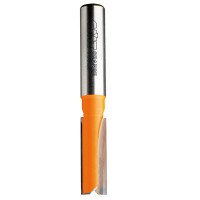
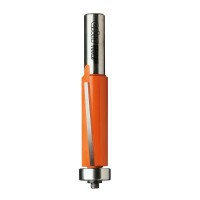
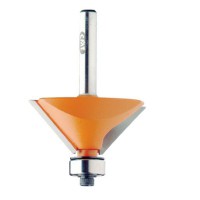
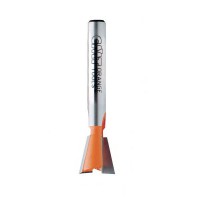
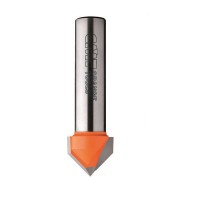
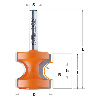
It is much more sensible to buy a few quality basic blades separately as needed. Most woodworking tasks, such as building furniture and making shelves, are handled perfectly with three basic types:
By investing in these basic types, you can get tools for the same money that cut wood effortlessly and last a long time with regular use. When a special project requires a specific profile, you can purchase it as an individual quality product only when needed.
The diameter of the milling cutter shank directly affects the mechanical durability of the tool and the stability of the machining. In Finland, the most common shank sizes are 6 mm, 8 mm and 12 mm. Although the same profile of the blade is available in different shank sizes, a thicker shank usually costs slightly more due to the amount of manufacturing material and more demanding production.
As the diameter of the shank increases, its strength and rigidity increase significantly. For example, a 12 mm shank has more than double the cross-sectional area of ??an 8 mm shank. The thicker shank will not bend or vibrate even under heavy loads. A thin 6 mm or 8 mm shank, on the other hand, will easily flex slightly when making a deep groove in hard wood. This slight deflection causes vibration, which impairs the machining result and puts strain on the router bearings.
Choosing a larger shank size is a smart investment that will result in a cleaner finish and save money on the machine. If you can just get a larger sleeve for your router, a router bit with a 12 mm shank is always a more stable and safer choice for demanding jobs.
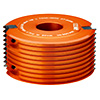
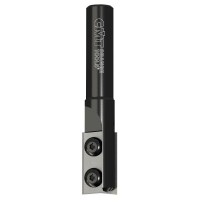
When woodworking becomes regular, indexable router bits are an option worth considering. In an indexable tool, the blade body itself is made of solid steel, and the cutting edges are screwed onto it as small, separate pieces of carbide.
A standard brazed milling cutter must be sent for sharpening when it becomes dull. Sharpening is expensive and the diameter of the cutter decreases with each sharpening. When making precise joints, the changed diameter requires constant adjustment of the machine tool and running test pieces.
Reversible blades solve these problems:
Reversible blade tools are a good choice when working with high-wear materials such as MDF, plywood or very hard hardwoods. The adhesives and dense fibers of these materials dull a traditional blade quickly, making the ease and economy of a reversible blade even more important.
Some high-quality milling cutters have colorful coatings on their surfaces. This is not decoration, but a technical coating (such as PTFE or Teflon-based compounds) that reduces friction during machining.
Due to the higher rotation speed, a lot of friction and heat are generated during milling. Heat, in turn, weakens the carbide. When the blade gets too hot, the cobalt that acts as its bonding agent begins to lose its strength, causing the cutting edge to crumble microscopically and dull quickly. The coating also prevents resin from burning onto the blade. A resinous blade heats up more easily and leaves black burn marks on the wood.
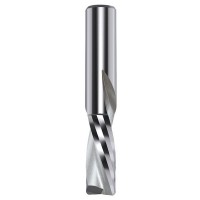
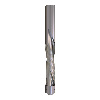
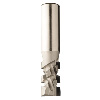
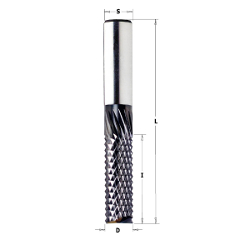
Solid carbide spiral cutters are the pinnacle of milling. Traditional straight cutters strike the wood at a right angle, but a spiral cutter cuts the wood in a continuous, rolling motion – similar to a metalworking router.
Although the purchase price of a spiral blade or a coated blade is higher, the benefits are reflected in the quality of work and durability. The blade stays sharp for significantly longer, and valuable material is not wasted due to chips or burn marks.
In woodworking, quality tools save time, improve work safety and ensure a clean end result. By choosing a router bit that is balanced and made of high-quality carbide and is suitable for your application, you ensure that the work goes smoothly and the joints are made successfully in one go.
100% Trustworthy online store with history
Expert customer service
Fast deliveries
Large selection directly from stock
No middlemen - save on the price






 Suomeksi
 På Svenska