Login
Login
Shipping Country
Super CLEARANCE CAMPAIGN - Selected tools and accessories with Super Special prices! - CHECK HERE
READ MORE
Login
Woodworking produces a lot of fine dust and chips, which must be efficiently removed from the machines for safety and comfort. When building a fixed or semi-fixed line in a workshop, attention is usually paid to the suction power, pipe diameters and shutters. However, one key factor is too often overlooked: static electricity.
The air flow speed in sawdust removal is typically over 20 meters per second. At this speed, each wood chip and dust particle rubs against the pipe wall thousands of times. When dry sawdust flows at high speed through the insulating material, a strong electrical charge is created in the system. The voltage that builds up on the surface of the pipe can quickly increase to thousands of volts. In the worst case, the voltage is released as an uncontrolled spark that can ignite dust floating in the air. However, with proper grounding, this danger is easy to prevent.
The formation of static electricity is based on the triboelectric phenomenon. When two different materials – in this case, dry wood particles and the inside of a pipe – rub against each other and separate rapidly, electrons are transferred from one material to the other. Wood readily donates electrons, and most commonly used plastics, such as PVC, accept them.
Because ordinary plastic is an effective insulator, the electrical charge that accumulates on its surface cannot move forward or discharge to the ground on its own. The charge is left waiting for an easier path. If you bring your hand close to a charged pipe, the electricity will jump through the air to your fingers and cause a nasty shock. In a workshop environment, even a simple jolt can be dangerous if you are holding a rotating tool or workpiece in your hand.
A spark needs to be generated by a sufficiently large potential difference between the surface of the pipe and a nearby grounded object. When the potential becomes too high, the insulating properties of the air fail and an electrical discharge, or spark, is generated. If this occurs at a point where fine grinding dust is suspended in the air in the right mixture with oxygen, the result can be a dust fire or a dust explosion. According to accident investigations, wood dust explosions are exceptionally destructive. The first small explosion is often followed by a much more powerful after-explosion, as the vibration lifts the dust accumulated on the workshop surfaces into the air.
The choice of piping material directly determines how much effort is required for grounding and safety. Many people build their hobby workshop lines from gray PVC sewer pipe due to its affordability and ease of availability. However, from an electrical engineering perspective, this is the most challenging solution. Since electrical charge does not move on the surface of plastic, simply winding copper wire around the outside of the pipe is not enough to remove the charge from the inner surface, where the flow occurs.
If you want to ground a PVC pipe, you need to run a bare copper wire inside the pipe so that it is in direct contact with the flowing wood. However, this creates a new problem: the wire easily collects long wood shavings and fibers around it, which will eventually clog the pipe.
When choosing an efficient and reliable wood dust extractor for your workshop, it is a good idea to choose a model made of antistatic polyurethane (PU) for the hose. Antistatic hoses have an integrated steel spiral reinforcement that acts as a conductor. When this metal spiral is connected to metal fittings or directly to the body of the vacuum cleaner, the electrical charge can be discharged to the ground without any wires inside the pipe.
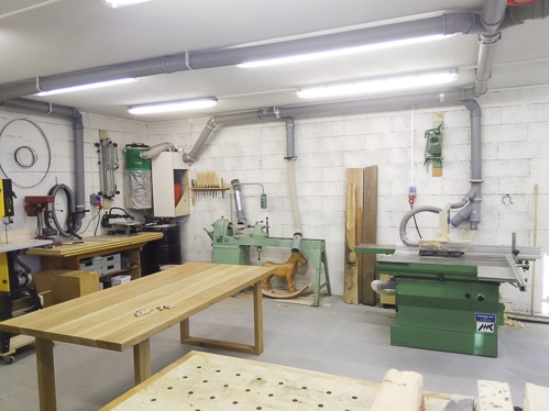
Professional installations almost always use galvanized steel, or spiral-seamed pipe. Metal conducts electricity naturally, so the entire pipe system acts as one large protective conductor. Metal piping only requires that all joints are electrically connected to each other – this is ensured, for example, by pop rivets or jumper wires – and that the system is reliably connected to the protective earth of the electrical network. The smooth metal surface also reduces air resistance, allowing the best possible benefit from the suction power.
A functional and safe grounding system does not require complicated electrical installations, as long as the basic principles are clear and the connections are made carefully. The idea of ??grounding is to create an uninterrupted and low-resistance path for electrical charge from the pipeline directly to the protective earth of the electrical network. When the electricity can discharge in a controlled manner, dangerous voltage differences cannot build up on the surface of the pipes.
If the system uses a flexible, antistatic PU hose with a steel thread, grounding is relatively straightforward. Expose the end of the steel wire running inside the hose about a couple of centimetres from both ends. Push the exposed wire under the hose connector so that it is pressed tightly against the metal fitting or the machine frame. Secure the hose firmly with a metal hose clamp. The mechanical compression ensures that the electricity is transferred from the hose thread to the metal structures and from there to ground.
In a fixed metal pipe system, or threaded joint system, the biggest challenge is the pipe joints. Although the pipes are metal, the gaskets, adhesives, or sealing tapes used between them act as electrical insulators, allowing electrical charge to become trapped in a single section of the pipe. The problem is solved by installing a jumper wire across each joint. Screw or rivet a short piece of copper wire to the surfaces of the pipes to be connected so that the electrical connection continues uninterrupted throughout the entire line.
The dampers installed in the system, i.e. gate dampers, also require special attention. When selecting and installing damper dampers, their effect on electrical continuity must be taken into account. If you use plastic dampers in a metal pipe system, they will immediately break the electrical continuity. In this case, a jumper wire must always be installed across the dampers. If you use metal dampers, make sure that the sliding part of the damper is in electrical contact with the frame even when the gate is fully open or closed.
Nettiverstas offers high-quality and reliable equipment that you can use to build an efficient and safe working environment. In our selection you will find a dust extractor that suits your needs, high-quality antistatic PU hoses and all the necessary connecting accessories to maintain a clean and safe workspace. When you take care of dust removal in one go with the right tools, the work will go quickly and safely. Discover our solutions and choose professional-level equipment for your workshop.
EXPLORE THE WOOD VACUUM CLEANER RANGEAfter installation, the functionality of the system should not be left to guesswork, as a simple visual inspection will not reveal a poor electrical contact. The easiest and safest way to ensure the safety of the system is to use a standard multimeter to measure electrical resistance.
Set the multimeter to resistance (ohms, ?). Place one probe of the meter on a grounding point – for example, the metal frame of a vacuum cleaner connected to the protective earth of the electrical network – and the other probe on the farthest point in the pipework. To achieve reliable protection, the meter should show a low resistance value, preferably less than 10 ohms. Low resistance ensures that the electrical charge can flow to the ground in a fraction of a second without the risk of sparking or electric shock.
If the meter shows infinite resistance (often the display reads "OL" or Over Limit), the electrical circuit is broken somewhere. In this case, go through the piping connection by connection. Typical causes of the fault are loose hose clamps, lack of unpainted metal surface under the screw connection or a broken ground wire. According to the general guidelines of the Finnish Safety and Chemicals Agency (Tukes), connections related to fixed electrical installations should always be left to a professional, but you can safely measure and repair the internal jumper wires and hose connections in the piping yourself.
A properly designed and regularly maintained dust extraction system keeps your workshop workspace safe and functional. When static shocks and dust fire hazards are eliminated with proper grounding, you can fully focus on precise, high-quality woodworking.
100% Trustworthy online store with history
Expert customer service
Fast deliveries
Large selection directly from stock
No middlemen - save on the price






 Suomeksi
 På Svenska